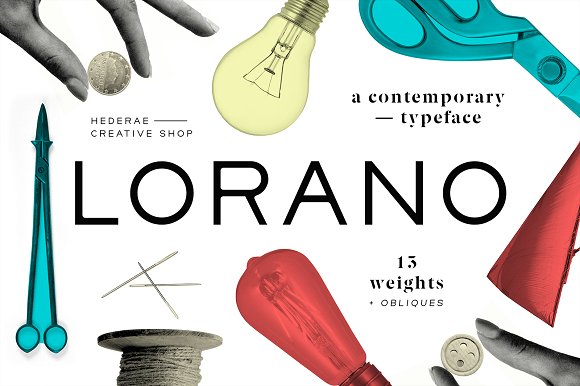
Lorano: Integrating a Geometric Sans Serif into Modern Design Workflows
In the landscape of modern typography, selecting a font is rarely an aesthetic-only decision. It is a functional choice that impacts load times, readability across devices, and the overall cohesion of a brand identity. Lorano, a contemporary sans serif created by the Hederae Type Foundry, addresses these practical needs by offering a strong geometric foundation rooted in rationalism and minimalism. This typeface is not merely a collection of letters; it is a tool designed for precision in user interfaces, logotypes, and editorial layouts.
Design Philosophy: Rationalism and Geometry
Understanding the construction of Lorano is the first step in utilizing it effectively. The font is defined by pure geometries and rounded right angles (1.40pt). This specific rounding softens the harshness often associated with strict geometric sans serifs, allowing the typeface to feel approachable while maintaining a rigid structure. The design draws inspiration from rationalist movements, focusing on clarity and order.
A critical technical feature of Lorano is its medium-large x-height combined with slightly wider horizontal proportions. In practical terms, this means the lowercase letters are taller and wider than average, which significantly enhances legibility at small sizes. For designers working on mobile applications or responsive websites, this characteristic ensures that body text remains readable without requiring excessive font sizes, optimizing screen real estate.
Technical Specifications and Asset Management
Before integrating Lorano into a project, it is essential to understand the scope of the family and the file formats provided. The typeface offers a massive range of 13 weights and obliques, spanning from Thin to ExtraBlack, totaling 26 fonts. This extensive range allows for a complete typographic hierarchy without mixing font families, ensuring visual consistency from headlines to fine print.
The asset package is prepared for modern development pipelines. It includes OTF and TTF for desktop installation and design software, alongside WebFonts formats: EOT, WOFF, and WOFF2. When implementing Lorano on the web, prioritizing WOFF2 is advisable for the best compression and performance. For project organization, establishing a clear file structure for these weights early in the process prevents version control issues later.
Workflow Integration: From Concept to Execution
Integrating Lorano into a workflow depends heavily on the project phase. For branding and logotypes, the font should be introduced during the conceptualization phase. Its pure geometries allow it to pair well with complex imagery or stand alone as a minimalist wordmark. The "ExtraBlack" weight provides the necessary impact for headers, while the "Thin" weight offers an elegant contrast for secondary information.
During the execution phase of UI/UX design, Lorano serves as a reliable backbone. Its wide horizontal proportions reduce the "rivers" of white space that can appear in justified text, and its clear letterforms reduce cognitive load for users scanning interface elements. When working with prototyping tools like Figma or Adobe XD, utilizing the variable weight capabilities (or distinct static weights) allows for rapid iteration of visual hierarchy without breaking the grid system.
Practical Application and Use Cases
The versatility of Lorano makes it suitable for a variety of specific applications. Its geometry makes it particularly effective for user interfaces and mobile apps, where clarity is paramount. However, its sophisticated spacing potential allows it to function in high-end editorial and branding contexts.
Consider the following implementation scenarios:
- Magazine Layouts: Use Lorano with wide tracking (letter-spacing) for headlines to achieve a sophisticated, airy look. This leverages the font's geometric nature to create architectural space on the page.
- Short Text and Captions: The medium-large x-height ensures that even at 10px or 11px, metadata, timestamps, or photo captions remain legible.
- Logotypes: The rounded right angles provide a modern, friendly feel that suits tech startups, educational platforms, and creative agencies alike.
- Long-form Reading: While optimized for UI, the "Regular" and "Medium" weights are spaced sufficiently to handle short-to-medium blocks of body text in magazines or blogs without causing eye strain.
Compatibility and Language Support
A significant logistical advantage of Lorano is its extensive language support. The font covers a wide range of Latin-based scripts, including Albanian, Catalan, Croatian, Czech, Danish, Dutch, Esperanto, Estonian, Filipino, Finnish (Suomi), West Frisian, French, Hungarian, Irish, Italian, Latvian, Lithuanian, Norwegian, Polish, Portuguese, Romanian, Serbian, Slovenian, Spanish, Swedish, Turkish, Welsh, English, and German.
For global brands or publishers targeting European markets, this eliminates the need for fallback fonts that might disrupt the visual flow. In a CMS (Content Management System) environment, configuring Lorano as the primary typeface ensures that content in these supported languages renders correctly without manual intervention, maintaining the design's integrity across different locales.
Optimization and Long-Term Use
To maximize the efficiency of Lorano in a long-term project, consider the following implementation tips:
- Subsetting: If bandwidth is a concern, subset the web fonts to include only the specific characters and languages needed for the project. This reduces file size while keeping the aesthetic consistent.
- Variable Font Fallback: Until variable font support is universal, ensure that your CSS includes a robust font stack that defines specific weights (e.g.,
font-weight: 400for Regular,font-weight: 700for Bold) rather than relying on browser interpolation. - Contrast Pairing: While Lorano can stand alone, it pairs effectively with serif fonts that have a rational structure. This creates a dynamic tension between geometric rigidity and organic flow, useful for editorial designs that require both authority and approachability.
By treating Lorano not just as a font choice but as a structural component of the design system, professionals can leverage its geometric precision to create work that is both aesthetically pleasing and functionally superior. Its balance of minimalism and usability makes it a durable asset for any digital or print toolkit.